MANAWA - With a UW-Madison degree and nearly 20 years of livestock nutrition experience, Bill Keough is putting his knowledge to work on his own small herd of Dorset sheep.
"I guess, basically, I try to practice what I preach. Not many nutritionists actually raise animals and feed animals," he told a group of sheep raisers Sept. 13 at a pasture walk he hosted at his Cedar Lane Dorsets facility.
Mr. Keough chose Dorset sheep when he was 13 years old and showed them in 4-H and FFA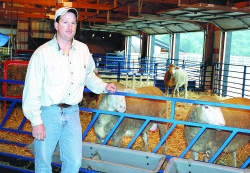 before selling the flock. before selling the flock.
"I went 19 years without them," he said. "It's been a burr up my rear for 19 years. I just wanted them back. It's in the blood."
In 2004, he and a friend built and outfitted a pole barn for sheep handling and began fencing 7 of his 20 acres for intensive rotational grazing. The flock came a year later.
Mr. Keough set a goal for his herd right at the start: He expects about a third of the lambs to be show and breeding quality, but the other two-thirds still have to excel as meat animals.
He's using his experience with nutrition to help meet that goal.
"With me, what I'm trying to do is maximize their growth for their genetics," Mr. Keough said."
He uses sedars and prostaglandin to breed his ewes out of season so he has lambs ready for shows and sales in March.
"With the registered Dorsets, fall-born lambs are a premium. Plus, it's nicer lambing in September than January," he said.
Lambs are put on creep feed immediately and are fed the same ration whether they are destined for meat or show. They are weaned between 45 and 72 days.
"In other words, right after or before deer hunting," he quipped.
Most sheep raisers keep their lambs on the ewes while they're on pasture during the summer. They don't start feeding grain until fall weaning.
"They start thinking about grain after mine are gone and sold," he said. He consistently has ram lambs at 140 pounds in less than 4 months.
At that age, show, sale and replacement prospects are set aside, and the meat lambs are sold directly to customers as locker lambs. He said his primary advertising is word of mouth, but he's just put together a flier with tear-off telephone numbers to be put up at the local feed mill and other outlets.
He charges a carcass price of $2.65 a pound and in the flier includes comparisons with grocery store lamb prices. His price is less than $5 a pound for finished lamb, and two-thirds of the cuts would be $10 to $12 a pound in the supermarket.
Mr. Keough said he can make a profit with meat if his ewes produce twins, but he will take the profit wherever he can get it.
"My first emphasis is on the show and sales, but if I can make more money selling direct ... ," he said. "My goal next year is to break even on the whole thing. Considering that will only be my true third year, that's pretty aggressive."
On the show and sale side, he's already made a name for himself, selling a pair of rams last year for $900 and $1,000, and selling another one this spring for $2,500.
Mr. Keough said he doesn't worry about spending a little extra money to feed his meat lambs because he doesn't have a lot of them - maybe 17 a year. He still tracks every penny, so he knows his costs.
When planning a ration for his customers, his goal is to tailor the plan to the individual and offer options that will grow the animals most efficiently.
He said the result depends on the farmer. All the fine-tuning in the world won't improve feed efficiency if a sheep raiser takes shortcuts in management practices.
"In other words, if you are feeding sheep and their environment is crappy, it doesn't matter what you feed them. The best gains are going to be by the best managers," he said.
"Shortcuts don't make you money. People who take shortcuts aren't going to be as profitable," he said.
With sheep, he said that could be something as basic as compromising the lambs' growth by choosing one feed for all stages of growth.
"My lambs go through seven different diets before they're 9 months old," Mr. Keough said. "I'm always changing that diet for the next stage of growth."
Mr. Keough is also planning his farm for its next stage of growth. He wants to set up irrigation on his pastures with hopes of extending from 100 days to 200 days of grazing for the ewes.
"If I can have the irrigated pasture, I am looking at rotating every two days (through) what would be a quarter-acre," he said. "This is my plan. Reality can always be different."
If his grass-hay supply holds until he can make better use of pastures, he can reduce that cost from $5,000 to $2,000 annually.
Barn space is at a premium for his 32 head, but he said a second barn would allow him to accelerate breeding so he has spring lambs for replacement. He plans to build to 40 brood ewes.
For more information about Mr. Keough's nutrition plans, call him at Bear Lake Enterprises, (920) 596-1931, or visit www.bksheep.com. |